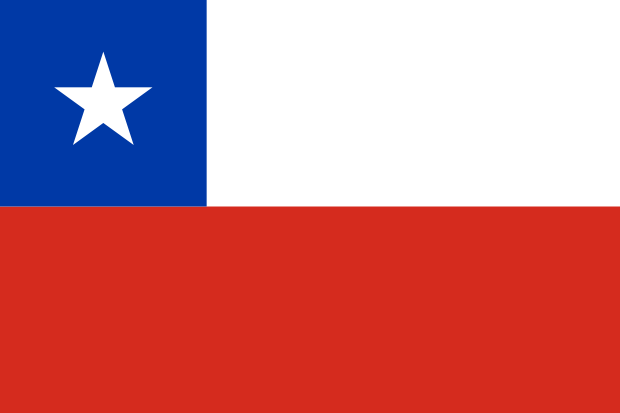
Chile

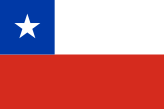
Country flag available in this resolutions
| Icon 32x21 | ![]() |
| Icon 88x59 | ![]() |
Chile
Chile, a nation of staggering contrasts and unparalleled geographical diversity, stretches like a narrow ribbon along South America’s southwestern coast, embracing the Pacific Ocean to its west and the towering Andes Mountains to its east. Its extreme length—over 4,300 kilometers—and an average width of just 177 kilometers make it one of the world’s most uniquely shaped countries, a characteristic that profoundly influences its climate, ecosystems, and human settlement patterns. From the arid, mineral-rich Atacama Desert in the north, home to some of the driest places on Earth, the landscape transitions through a Mediterranean climate in the central valley, ideal for agriculture and viticulture, to the alpine tundras, ancient forests, and fjords of Patagonia in the south. This remarkable geographical spectrum also encompasses remote territories such as Easter Island (Rapa Nui) in the Pacific and the Juan Fernández Archipelago, adding further layers to its natural and cultural tapestry. The Andes serve not only as a natural border but also as a source of vital water resources and a dramatic backdrop to much of the country, while the Pacific Ocean shapes its climate, provides abundant marine life, and serves as a crucial gateway for trade.
The history of Chile is a compelling narrative of indigenous resilience, colonial subjugation, and a complex journey towards modern statehood. Prior to the arrival of Europeans, various indigenous groups inhabited the territory, most notably the Mapuche people in the central and southern regions, who fiercely resisted Inca expansion and later, Spanish conquest. Pedro de Valdivia founded Santiago in 1541, marking the beginning of Spanish colonial rule, which was characterized by ongoing conflicts with the Mapuche, who were never fully subjugated. Chile gained independence from Spain in 1818, largely through the efforts of Bernardo O’Higgins, one of the nation’s founding fathers. The 19th century saw territorial expansion, most significantly following the War of the Pacific (1879-1883), which granted Chile control over vast nitrate and copper deposits in the northern desert, fueling significant economic growth. The 20th century was marked by periods of political instability, culminating in the election of socialist Salvador Allende in 1970, whose government was overthrown in a military coup in 1973. This ushered in a brutal 17-year dictatorship under General Augusto Pinochet, characterized by widespread human rights abuses, but also significant free-market economic reforms. Chile transitioned back to democracy peacefully in 1990, embarking on a path of reconciliation and economic liberalization.
Demographically, Chile is a nation of approximately 19 million people, with a significant majority residing in urban areas, particularly the capital city of Santiago, which is home to over a third of the national population. The ethnic composition is predominantly Mestizo, a blend of European (primarily Spanish) and indigenous heritage, alongside a substantial proportion of people of primarily European descent, often from later immigrant waves (e.g., German, Italian, Croatian). Indigenous peoples, predominantly the Mapuche, constitute a significant minority, preserving their language and cultural traditions, especially in the south-central regions. Spanish is the official language, and Roman Catholicism remains the largest religion, though evangelical Protestantism has seen considerable growth in recent decades. Chile boasts a relatively high Human Development Index (HDI) for Latin America, reflecting strong performance in education, healthcare, and living standards. However, despite overall progress, social inequality remains a persistent challenge, with ongoing efforts to bridge the gap between different socioeconomic strata and ensure equitable access to opportunities.
Chile’s economy is one of the most robust and open in South America, largely driven by its rich natural resources and a commitment to free-market principles. The country is the world’s largest producer and exporter of copper, with mining forming the backbone of its economy. Other significant mineral resources include lithium, molybdenum, and iron. Beyond mining, agriculture plays a crucial role, particularly in the central valley, where Chile has become a leading exporter of fresh fruit, including grapes, apples, and blueberries. The country’s burgeoning wine industry has also gained international acclaim, with Chilean wines being highly sought after globally. Fisheries and forestry are other important sectors, benefiting from Chile’s extensive coastline and diverse forests. In recent decades, the service sector, including finance, tourism, and technology, has expanded, contributing to economic diversification. Chile has actively pursued free trade agreements with numerous countries and blocs worldwide, further integrating its economy into global markets. While its reliance on commodity prices, especially copper, can make it vulnerable to global market fluctuations, the country’s sound macroeconomic policies and institutional stability have generally fostered sustained economic growth and attracted foreign investment.
Information about country Chile
Automated text translation, excuse errors, please!
Informations are from the publication CIA The World Factbook.
Country Chile is situated in a location / continent South America. Chile has an area of 756 102 km2 and 17 067 369 residents. The highest point has a height 6 880 above sea level. and it is called Nevado Ojos del Salado. The lowest point is located at the level of 0 above sea level and it is named Pacific Ocean. System of government is republic and the date of independence 18th September 1810. The capital city is Santiago. Chile has the international abbreviation CI.
Chile - economy
Total gross domestic product (GDP) is 303 500 000 000 $. Total gross domestic product per capita in purchasing power parity is 17 400 $. GDP grows by 5.90 % a year. Inflation (consumer price index) is equal to 3.30 % a year. Chile have 8 099 000 working-age population (from a total population 17 067 369 people). Unemployment is at 6.60 %. Chile issued 8.20 % GDP to healt care and 2,70 % GDP to army. The public debt of the country is 9.20 % GDP. The total amount of foreign debt is 99 400 000 000 USD.
Chile - transport and telecommunications
Chile has 80 505 km of roads, 7 082 km of railway lines and 476 airports. There is registered 42 ships.
Number of active mobile phones (sim card) in the country Chile is 22 400 000. Number of active fixed telephone lines is 3 366 000. Chile has 7 009 000 internet users, who have the available 1 854 000 Internet connections. Chile has been assigned a domain first Choose range .cl.
Chile - demography
As suggested above, Chile has 17 067 369 people. Population growth is in the amount 0.88 % per year. Number of children born per 1000 population per year is 14.28.Every mother has average 1.87 children. The infant mortality rate is 7.36 and maternal mortality 25.00 deaths per 100,000 births. Average estimated life expectancy makes 78.10 years. Mortality is 5.79 people per 1000 population per year.
Chile - energetics
Chile consumes a year 53 240 000 000 kWh of electricity. Annual electricity production is 59 750 000 000 kWh in power plants with a total installed electrical capacity 15 520 000 kW. Chile exports 0 kWh and imports 958 000 000 kWh of electricity per year Energy mix of power generation is as follows: fossil fuels: 64.4 %, nuclear energy: 0 %, renewable: 0.7 %, hydropower: 34.8 %. The country Chile is harvested annually 6 000 barrels of oil.
Flags of countries
World flags
World countries flags

Dále doporučujeme:
Zajímavé internetové odkazyZajímavé webové stránky
Doporučené internetové odkazy
Odkazy na zajímavé weby
Doporučené odkazy
![]() |
![]() |
![]() |
![]() |
![]() |
![]() |
![]() |
![]() |
![]() |
![]() |
![]() |
![]() |
![]() |
![]() |
![]() |
![]() |
![]() |
![]() |
![]() |