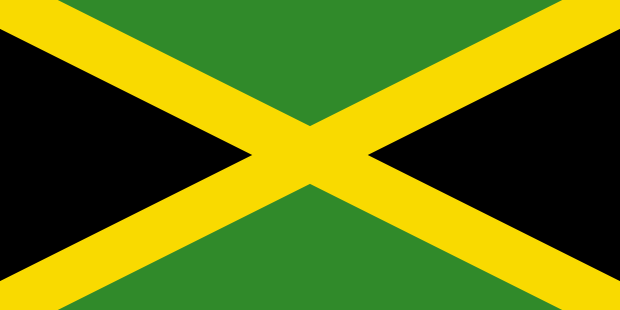
Jamaica

Country flag available in this resolutions
| Icon 32x16 | ![]() |
| Icon 88x44 | ![]() |
Jamaica
Jamaica, a jewel of the Caribbean, captivates with its vibrant culture, stunning landscapes, and a history as rich and complex as its famous Blue Mountain coffee. More than just a tropical paradise, this island nation has carved out a distinct identity on the global stage, influencing music, sports, and social thought far beyond its shores. It is a land of paradoxes, where profound natural beauty coexists with historical struggles, and an indomitable spirit of resilience defines its people.
Geography: Geographically, Jamaica is the third-largest island in the Greater Antilles, stretching approximately 234 kilometers (145 miles) in length and 80 kilometers (50 miles) in width, encompassing an area of 10,991 square kilometers (4,244 sq mi). Its topography is dominated by a central spine of mountains, most notably the majestic Blue Mountains in the east, which culminate at Blue Mountain Peak, the highest point at 2,256 meters (7,402 ft). From these verdant heights, numerous rivers cascade down to the fertile coastal plains, which are fringed by breathtaking white-sand beaches, coral reefs, and dramatic cliffs. The island’s tropical climate is characterized by hot, humid conditions year-round, moderated by sea breezes, with a distinct wet season from May to November, making it susceptible to hurricanes. This diverse landscape supports a rich biodiversity, including unique flora and fauna, making it a hotspot for nature lovers and adventurers alike.
History: Jamaica’s history is a compelling narrative of conquest, resistance, and eventual liberation. The island’s first inhabitants were the indigenous Taíno people, who called it „Xaymaca,“ meaning „land of wood and water.“ Christopher Columbus claimed the island for Spain in 1494, leading to the decimation of the Taíno population through disease and forced labor. In 1655, the British seized Jamaica, transforming it into one of the most profitable sugar colonies in the world, fueled by the brutal system of chattel slavery. Hundreds of thousands of enslaved Africans were brought to the island, their labor driving its economy, but also sowing the seeds of rebellion and cultural fusion. The spirit of resistance was embodied by figures like the Maroons, who established independent communities in the island’s interior. Slavery was finally abolished in 1838, paving the way for a long struggle towards self-governance. Jamaica gained full independence from the United Kingdom on August 6, 1962, marking a new chapter in its journey as a sovereign nation, though retaining its ties to the Commonwealth.
Demographics: Demographically, Jamaica is a melting pot, though predominantly of African descent. With a population of approximately 2.8 million people, the vast majority (around 92%) identify as Black or of African ancestry, reflecting the legacy of the transatlantic slave trade. Significant minority groups include people of mixed race, East Indian, Chinese, European, and Syrian/Lebanese descent, each contributing to the island’s rich cultural tapestry. English is the official language, used in government and education, but the vibrant Jamaican Patois (or Patwa), an English-based creole with West African influences, is widely spoken and serves as a powerful symbol of national identity. Christianity is the dominant religion, with various denominations, alongside the indigenous Rastafarian movement, which originated in Jamaica and has gained global recognition. This diverse population contributes to a dynamic social fabric, where different traditions and perspectives intertwine.
Economy: The Jamaican economy is primarily driven by three key sectors: tourism, bauxite/alumina mining, and agriculture. Tourism is by far the largest foreign exchange earner, attracting millions of visitors annually to its pristine beaches, luxurious resorts, and cultural attractions, particularly in areas like Montego Bay, Ocho Rios, and Negril. The island is also one of the world’s leading producers of bauxite and alumina, though this sector has faced fluctuating global prices. Agriculture, historically the backbone of the economy, continues to produce cash crops such as sugar cane, bananas, coffee (especially the world-renowned Blue Mountain coffee), and spices, alongside a growing domestic food market. However, Jamaica faces economic challenges including high public debt, vulnerability to natural disasters, and issues related to crime and security, which can impact investment and growth. Efforts are continuously made towards economic diversification, enhancing infrastructure, and fostering sustainable development to build a more resilient and prosperous future for its citizens.
Culture: Jamaica’s cultural impact on the world stage is disproportionate to its size. It is the birthplace of reggae music, a genre that emerged in the late 1960s with iconic figures like Bob Marley, whose messages of peace, love, and social justice resonated globally and earned him international superstardom. Reggae’s influence spawned other genres such as ska, rocksteady, and dancehall, continuing to shape contemporary music. The Rastafarian movement, with its distinctive spiritual beliefs, dreadlocks, and vegetarian diet, also originated in Jamaica and has become a global cultural phenomenon. Jamaican cuisine, celebrated for its bold flavors, includes world-famous dishes like jerk chicken or pork, ackee and saltfish (the national dish), patties, and callaloo. Sports are deeply ingrained in the national psyche, with Jamaica excelling in track and field athletics, producing Olympic champions like Usain Bolt, and also having a strong tradition in cricket. This vibrant cultural heritage, expressed through music, food, art, and sport, is a testament to the creativity and spirit of the Jamaican people.
In essence, Jamaica is an island of profound contrasts and enduring charm. From the majestic peaks of the Blue Mountains to the sun-kissed shores of its Caribbean coast, it offers a sensory feast. Its history is a testament to resilience, its demographics a mosaic of global influences, and its economy a blend of traditional industries and modern aspirations. Above all, it is the indomitable spirit and creative energy of its people, expressed through their music, cuisine, and vibrant way of life, that truly define Jamaica and ensure its continued global relevance and appeal. It remains a powerful symbol of identity, freedom, and the infectious rhythm of life.
Information about country Jamaica
Automated text translation, excuse errors, please!
Informations are from the publication CIA The World Factbook.
Country Jamaica is situated in a location / continent Central America. Jamaica has an area of 10 991 km2 and 2 889 187 residents. The highest point has a height 2 256 above sea level. and it is called Blue Mountain Peak. The lowest point is located at the level of 0 above sea level and it is named Caribbean Sea. System of government is Republic, Commonwealth member country and the date of independence 6th August 1962. The capital city is Kingston. Jamaica has the international abbreviation JM.
Jamaica - economy
Total gross domestic product (GDP) is 25 070 000 000 $. Total gross domestic product per capita in purchasing power parity is 9 100 $. GDP grows by 1.50 % a year. Inflation (consumer price index) is equal to 7.50 % a year. Jamaica have 1 324 000 working-age population (from a total population 2 889 187 people). Unemployment is at 12.70 %. Jamaica issued 8.30 % GDP to healt care and 0,60 % GDP to army. The public debt of the country is 125.50 % GDP. The total amount of foreign debt is 14 700 000 000 USD.
Jamaica - transport and telecommunications
Jamaica has 22 121 km of roads and 27 airports. There is registered 14 ships.
Number of active mobile phones (sim card) in the country Jamaica is 2 975 000. Number of active fixed telephone lines is 272 100. Jamaica has 1 581 000 internet users, who have the available 3 897 Internet connections. Jamaica has been assigned a domain first Choose range .jm.
Jamaica - demography
As suggested above, Jamaica has 2 889 187 people. Population growth is in the amount 0.71 % per year. Number of children born per 1000 population per year is 18.89.Every mother has average 2.12 children. The infant mortality rate is 14.30 and maternal mortality 110.00 deaths per 100,000 births. Average estimated life expectancy makes 73.43 years. Mortality is 6.59 people per 1000 population per year.
Jamaica - energetics
Jamaica consumes a year 4 801 000 000 kWh of electricity. Annual electricity production is 5 208 000 000 kWh in power plants with a total installed electrical capacity 1 198 000 kW. Jamaica exports 0 kWh and imports 0 kWh of electricity per year Energy mix of power generation is as follows: fossil fuels: 93.5 %, nuclear energy: 0 %, renewable: 4.7 %, hydropower: 1.8 %.
Flags of countries
World flags
World countries flags

Dále doporučujeme:
Zajímavé webové stránkyZajímavé linky na nejrůznější weby
Zajímavé internetové odkazy
Doporučené odkazy a zdroje obsahu
Odkazy na užitečné webové stránky
![]() |
![]() |
![]() |
![]() |
![]() |
![]() |
![]() |
![]() |
![]() |
![]() |
![]() |
![]() |
![]() |
![]() |
![]() |
![]() |
![]() |
![]() |
![]() |