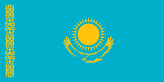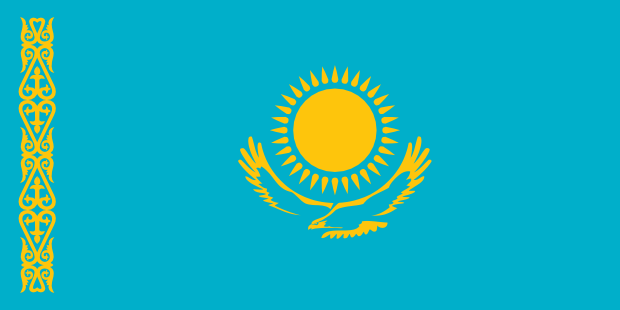
Kazakhstan

Country flag available in this resolutions
| Icon x | ![]() |
| Icon x | ![]() |
Kazakhstan
Kazakhstan, the world’s largest landlocked country and the ninth largest country overall, spans an immense territory of over 2.7 million square kilometers in Central Asia, extending partly into Eastern Europe. Its vastness is defined by an extraordinary diversity of landscapes, from the extensive flat steppes that dominate its central and western regions to the towering peaks of the Altai and Tian Shan mountains in the east and southeast, reaching elevations of over 7,000 meters. This immense geographical expanse is bordered by Russia to the north, China to the east, and Kyrgyzstan, Uzbekistan, and Turkmenistan to the south, with a significant coastline along the landlocked Caspian Sea in the west. Major geographical features also include the substantial Lake Balkhash, the remnants of the Aral Sea, and vast desert areas like Kyzylkum and Moyunkum. The country’s geography has profoundly shaped its history, culture, and economy, acting as a historical bridge between East and West, famously traversed by the ancient Silk Road. Its continental climate is characterized by hot summers and extremely cold winters, with significant variations across its diverse topographical zones, supporting a wide range of ecosystems and agricultural possibilities.
The history of Kazakhstan is a rich tapestry woven from centuries of nomadic traditions, imperial conquests, and modern nation-building. For millennia, the vast Kazakh steppe was home to various nomadic Turkic tribes, including the Scythians, Huns, and later the Turkic Khaganates, who forged powerful empires. The distinct Kazakh identity began to coalesce in the 15th and 16th centuries with the formation of the Kazakh Khanate, a formidable nomadic state known for its equestrian skills and warrior culture. However, by the 18th and 19th centuries, the region gradually fell under the influence and eventual control of the Russian Empire, leading to significant demographic and cultural shifts, including the establishment of Russian settlements. The Soviet era, from 1920 to 1991, brought further profound transformations, including forced collectivization, which led to devastating famines in the 1930s claiming millions of lives, industrialization, and the infamous Virgin Lands Campaign that converted vast steppes into agricultural land, alongside the settlement of ethnic Russians and other nationalities. Kazakhstan also became a key site for Soviet nuclear testing (at Semipalatinsk) and space exploration (with the Baikonur Cosmodrome remaining a crucial global space launch facility). On December 16, 1991, Kazakhstan declared its independence, marking a new chapter in its long history and embarking on a path of sovereign development and economic reform under its first president, Nursultan Nazarbayev.
Kazakhstan’s demographic landscape is as diverse as its geography, reflecting its complex history as a crossroads of civilizations. With a population of over 19.8 million people, it is home to more than 130 distinct ethnic groups, a legacy of centuries of migration and Soviet-era population transfers. The titular Kazakhs constitute the largest ethnic group, comprising over 70% of the population, followed by a significant Russian minority, particularly concentrated in the northern regions and major cities like Almaty and Astana (now Nur-Sultan, then Astana again). Other notable ethnic groups include Uzbeks, Ukrainians, Uyghurs, Tatars, and Germans. This ethnic mosaic is mirrored in its linguistic diversity; while Kazakh is the state language and its usage is actively promoted, Russian retains an official status and is widely used in business, government, and everyday communication, especially in urban areas and for inter-ethnic dialogue. Islam, predominantly Sunni, is the most widespread religion, practiced by the majority of Kazakhs and other Turkic groups, while Orthodox Christianity is prevalent among the Russian and Ukrainian communities. The country has experienced steady population growth since independence, driven by high birth rates and a return of ethnic Kazakhs from abroad, alongside increasing urbanization.
The economy of Kazakhstan is the largest in Central Asia, primarily driven by its vast natural resource wealth. The country possesses immense reserves of oil, natural gas, uranium, copper, chromium, lead, zinc, and coal, making it a major global producer and exporter of these commodities. The energy sector, particularly oil and gas, accounts for a significant portion of its GDP and export earnings, attracting substantial foreign direct investment from international companies. Beyond hydrocarbons, Kazakhstan is also the world’s largest producer of uranium. Agriculture remains an important sector, with the vast steppes supporting extensive grain farming, especially wheat, and robust livestock raising. Industrial development, including metallurgy, chemical production, and machinery, complements its resource extraction. In recent years, the government has actively pursued diversification strategies through programs like „Kazakhstan 2050,“ aiming to reduce reliance on raw materials by investing in manufacturing, logistics, and digital technologies. The country’s strategic location also positions it as a crucial transit hub for trade between Europe and Asia, playing a key role in China’s Belt and Road Initiative and enhancing its economic prospects through improved infrastructure.
Kazakhstan’s culture is a vibrant blend of its ancient nomadic heritage and modern influences, continually evolving while preserving its unique identity. Traditional customs, music (such as the mesmerizing sounds of the dombra), folk arts, and a deeply ingrained sense of hospitality remain strong, particularly in rural areas and during national celebrations. Equestrian sports and hunting with birds of prey (falconry) are still cherished traditions. Meanwhile, urban centers embrace contemporary art, fashion, and global trends, fostering a dynamic cultural scene. The country is actively working to preserve its rich historical and cultural identity while fostering an open, multi-ethnic, and modern society. As a rapidly developing nation with a rich heritage and immense potential, Kazakhstan continues to play an increasingly important role on the global stage, engaging in multilateral diplomacy and striving for sustainable growth and prosperity for its diverse population. Its future is poised at the intersection of tradition and innovation, a testament to its resilience, strategic vision, and ambition to be a significant player in the 21st century.
Information about country Kazakhstan
Automated text translation, excuse errors, please!
Informations are from the publication CIA The World Factbook.
Country Kazakhstan is situated in a location / continent Central Asia. Kazakhstan has an area of 2 724 900 km2 and 17 522 010 residents. The highest point has a height 6 995 above sea level. and it is called Khan Tangiri Shyngy (Pik Khan-Tengri). The lowest point is located at the level of -132 above sea level and it is named Vpadina Kaunda. System of government is republic and the date of independence 16th December 1991. The capital city is Astana. Kazakhstan has the international abbreviation KZ.
Kazakhstan - economy
Total gross domestic product (GDP) is 219 600 000 000 $. Total gross domestic product per capita in purchasing power parity is 13 200 $. GDP grows by 7.50 % a year. Inflation (consumer price index) is equal to 8.40 % a year. Kazakhstan have 8 777 000 working-age population (from a total population 17 522 010 people). Unemployment is at 5.40 %. Kazakhstan issued 4.30 % GDP to healt care and 1,10 % GDP to army. The public debt of the country is 12.40 % GDP. The total amount of foreign debt is 122 900 000 000 USD.
Kazakhstan - transport and telecommunications
Kazakhstan has 93 612 km of roads, 15 079 km of railway lines and 97 airports. The total length of waterways (navigable rivers, canals, etc.) is 4 000 km. There is registered 11 ships.
Number of active mobile phones (sim card) in the country Kazakhstan is 23 103 000. Number of active fixed telephone lines is 4 237 000. Kazakhstan has 5 299 000 internet users, who have the available 65 988 Internet connections. Kazakhstan has been assigned a domain first Choose range .kz.
Kazakhstan - demography
As suggested above, Kazakhstan has 17 522 010 people. Population growth is in the amount 1.24 % per year. Number of children born per 1000 population per year is 20.44.Every mother has average 2.41 children. The infant mortality rate is 23.06 and maternal mortality 51.00 deaths per 100,000 births. Average estimated life expectancy makes 69.63 years. Mortality is 8.52 people per 1000 population per year.
Kazakhstan - energetics
Kazakhstan consumes a year 88 110 000 000 kWh of electricity. Annual electricity production is 86 200 000 000 kWh in power plants with a total installed electrical capacity 18 730 000 kW. Kazakhstan exports 1 800 000 000 kWh and imports 3 700 000 000 kWh of electricity per year Energy mix of power generation is as follows: fossil fuels: 88.2 %, nuclear energy: 0 %, renewable: 0.0 %, hydropower: 11.8 %. The country Kazakhstan is harvested annually 1 635 000 barrels of oil.
Flags of countries
World flags
World countries flags

Dále doporučujeme:
Linky na partnerské webyDoporučené odkazy na zajímavé weby
Tipy na zajímavé weby
Zajímavé internetové odkazy
Naše tipy na zajímavé stránky
![]() |
![]() |
![]() |
![]() |
![]() |
![]() |
![]() |
![]() |
![]() |
![]() |
![]() |
![]() |
![]() |
![]() |
![]() |
![]() |
![]() |
![]() |
![]() |