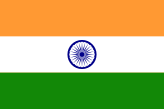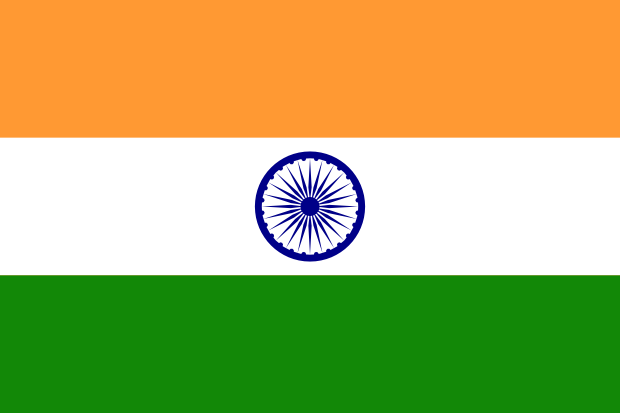
India

Country flag available in this resolutions
| Icon 32x21 | ![]() |
| Icon 88x59 | ![]() |
India
India, officially the Republic of India, is a colossal South Asian nation. It is the world’s most populous country and seventh-largest by land area, holding a pivotal global position. From ancient civilisations to a burgeoning modern economy, India represents a kaleidoscope of human experience, continuously evolving while cherishing deeply rooted traditions. Its sheer scale and complexity embody immense challenges and unparalleled opportunities.
Geography
Geographically, India is a land of striking contrasts. Bordered by the majestic Himalayas to the north, it extends southwards into the Indian Ocean, flanked by the Arabian Sea and Bay of Bengal. Its diverse topography includes the fertile Indo-Gangetic Plain, the arid Thar Desert, and the ancient Deccan plateaus. Climate varies dramatically, from alpine tundra in the Himalayas to tropical monsoons across the peninsula, profoundly shaping regional identities and economic activities. This geographical variance influences its rich biodiversity and agricultural practices.
History
India’s history dates to the Indus Valley Civilisation (around 2500 BCE), one of the earliest urban cultures. The Vedic period followed, laying foundations for Hinduism and early Indian philosophy. Powerful empires like the Maurya (unifying much of the subcontinent) and the Gupta (often referred to as India’s „Golden Age“ for its advancements in science and art) shaped ancient India. The medieval era saw Islamic sultanates and the mighty Mughal Empire, leaving indelible marks on Indian architecture, cuisine, and culture. British colonial rule, beginning in the 17th century, brought economic exploitation but also modern infrastructure. India achieved independence in 1947, following a non-violent movement led by Mahatma Gandhi, birthing the modern democratic nation.
Demography
With over 1.4 billion people, India is the world’s most populous nation, a demographic mosaic. It boasts immense linguistic diversity, with 22 official languages (Hindi and English are primary) and hundreds of other tongues. Religiously, India is predominantly Hindu, but also home to significant populations of Muslims, Christians, Sikhs, Buddhists, and Jains, making it one of the most religiously diverse countries globally. This diversity, while enriching, presents challenges for social cohesion. India’s population is relatively young, offering a demographic dividend but demanding sufficient employment opportunities. Rapid urbanisation, with megacities like Mumbai and Delhi growing, brings economic growth alongside infrastructural pressures.
Economy
India’s economy is one of the world’s fastest-growing, transitioning from an agrarian base to a diversified model. It is now the fifth-largest by nominal GDP and third-largest by purchasing power parity. The services sector, particularly information technology, business process outsourcing, and telecommunications, has been a major growth driver, making India a global IT powerhouse. Agriculture remains crucial, employing a large portion of the workforce and supporting rural livelihoods. Manufacturing, under initiatives like „Make in India,“ also gains momentum. Despite impressive growth, challenges like income inequality, poverty, and infrastructure deficits persist. The government pursues reforms to attract foreign investment and foster innovation, aiming for sustained and inclusive economic development.
Culture and Society
India’s cultural heritage is incredibly rich and ancient, embodying millennia of traditions, philosophies, and artistic expressions. It is the birthplace of four major world religions—Hinduism, Buddhism, Jainism, and Sikhism—deeply influencing global thought. Indian classical music, dance, vibrant festivals (Diwali, Holi), intricate textiles, and diverse culinary traditions are celebrated worldwide. The joint family system, though evolving, traditionally forms the bedrock of Indian society. While modern influences are pervasive, traditional values, respect for elders, and community spirit remain significant. The caste system, officially abolished, still influences social dynamics regionally, though its rigidities diminish in urban areas. India’s cultural tapestry absorbs diverse influences while maintaining a distinct identity.
Challenges and Future Outlook
Despite remarkable progress, India grapples with formidable challenges: poverty alleviation, equitable access to quality education and healthcare, environmental degradation, and infrastructure deficits. Political and social issues, like communal harmony and gender equality, also require ongoing focus. However, India’s large young population, robust democratic institutions, and growing economic might position it as a critical global player. Its strategic location, increasing geopolitical influence, and commitment to technological advancement suggest a future where India will continue to rise as a major economic and political power, shaping the 21st-century world. Its journey is a complex interplay of ancient wisdom and modern ambition, constantly striving to balance tradition with progress.
Information about country India
Automated text translation, excuse errors, please!
Informations are from the publication CIA The World Factbook.
Country India is situated in a location / continent South Asia. India has an area of 3 287 263 km2 and 1 205 073 612 residents. The highest point has a height 8 598 above sea level. and it is called Kanchenjunga. The lowest point is located at the level of 0 above sea level and it is named Indian Ocean. System of government is Federal Republic and the date of independence 15th August 1947. The capital city is New Delhi. India has the international abbreviation IN.
India - economy
Total gross domestic product (GDP) is 4 515 000 000 000 $. Total gross domestic product per capita in purchasing power parity is 3 700 $. GDP grows by 7.20 % a year. Inflation (consumer price index) is equal to 8.90 % a year. India have 487 600 000 working-age population (from a total population 1 205 073 612 people). Unemployment is at 9.80 %. India issued 2.40 % GDP to healt care and 2,50 % GDP to army. The public debt of the country is 48.50 % GDP. The total amount of foreign debt is 289 700 000 000 USD.
India - transport and telecommunications
India has 3 320 410 km of roads, 63 974 km of railway lines and 352 airports. The total length of waterways (navigable rivers, canals, etc.) is 14 500 km. There is registered 340 ships.
Number of active mobile phones (sim card) in the country India is 893 862 000. Number of active fixed telephone lines is 32 685 000. India has 61 338 000 internet users, who have the available 6 738 000 Internet connections. India has been assigned a domain first Choose range .in.
India - demography
As suggested above, India has 1 205 073 612 people. Population growth is in the amount 1.31 % per year. Number of children born per 1000 population per year is 20.60.Every mother has average 2.58 children. The infant mortality rate is 46.07 and maternal mortality 200.00 deaths per 100,000 births. Average estimated life expectancy makes 67.14 years. Mortality is 7.43 people per 1000 population per year.
India - energetics
India consumes a year 637 600 000 000 kWh of electricity. Annual electricity production is 880 000 000 000 kWh in power plants with a total installed electrical capacity 189 300 000 kW. India exports 519 000 000 kWh and imports 10 530 000 000 kWh of electricity per year Energy mix of power generation is as follows: fossil fuels: 69.9 %, nuclear energy: 2.2 %, renewable: 7.0 %, hydropower: 20.9 %. The country India is harvested annually 897 300 barrels of oil.
Flags of countries
World flags
World countries flags

Dále doporučujeme:
Tipy na zajímavé webyDoporučené odkazy na zajímavé weby
Odkazy na užitečné webové stránky
Tipy na užitečné weby
Linky na partnerské weby
![]() |
![]() |
![]() |
![]() |
![]() |
![]() |
![]() |
![]() |
![]() |
![]() |
![]() |
![]() |
![]() |
![]() |
![]() |
![]() |
![]() |
![]() |
![]() |