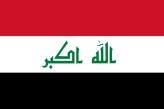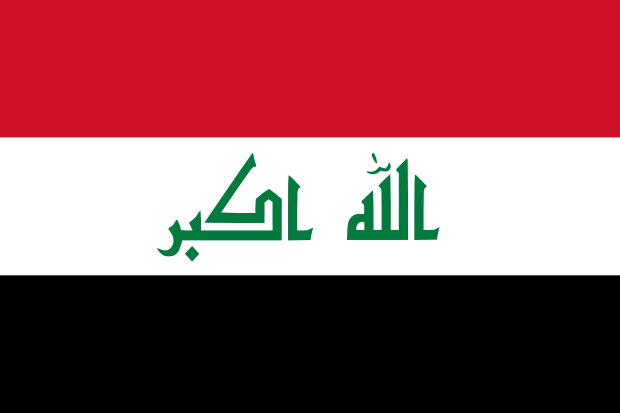
Iraq

Country flag available in this resolutions
| Icon 32x21 | ![]() |
| Icon 88x59 | ![]() |
Iraq
Iraq, officially the Republic of Iraq, is a country in Western Asia, historically known as Mesopotamia, the „land between the rivers“, a cradle of civilization that saw the birth of writing, agriculture, and early urban societies. This ancient land, rich in cultural heritage and natural resources, has experienced a tumultuous modern history, marked by conflict and political upheaval, yet it remains a nation of immense strategic importance and resilience.
Geographically, Iraq is dominated by the fertile plains of the Tigris and Euphrates rivers, which flow southeast and merge to form the Shatt al-Arab before emptying into the Persian Gulf. This riverine system has been the lifeblood of Iraq, supporting agriculture and populations for millennia. To the north and northeast, rugged mountains are home to the Kurdish population. The western and southern regions are largely arid desert. Iraq possesses vast reserves of crude oil, making it one of the world’s leading oil producers. Its climate varies from desert conditions in the south to more temperate conditions in the northern mountains.
Iraq’s history is unparalleled in its depth. It is the heartland of ancient Mesopotamia, where Sumerians developed the first writing system and city-states. Akkadian, Babylonian, and Assyrian empires left indelible marks, shaping early laws and architecture. The 7th century CE saw the arrival of Islam, transforming the region into a vibrant center of the Islamic Golden Age, with Baghdad becoming a global learning hub until the Mongol invasion. For centuries, Iraq was under Ottoman rule until World War I. After WWI, Britain’s mandate led to the establishment of the Kingdom of Iraq (1921), independent by 1932. The monarchy was overthrown in a 1958 coup, establishing the Republic. The Ba’ath Party’s 1968 rise led to Saddam Hussein’s authoritarian rule (1979-2003). This period was marked by the Iran-Iraq War (1980-88), the Gulf War, and sanctions. The 2003 US-led invasion toppled Saddam Hussein’s regime, initiating a complex period of occupation and conflict. Recent challenges include the rise and defeat of ISIS, continued political instability, and the immense task of reconstruction. Despite these profound challenges, the Iraqi people endure, striving for peace and prosperity amidst their glorious past.
Iraq, with over 43 million people, is ethnically diverse. Arabs form the majority, with Kurds being the largest minority in autonomous Kurdistan. Other groups include Turkmen, Assyrians, and Yazidis. Predominantly Muslim, with a Shia majority and a significant Sunni minority. Arabic is official, with Kurdish also official in Kurdistan.
Economically, Iraq is heavily reliant on its vast oil reserves. However, the economy faces challenges like corruption, inadequate infrastructure, and the need for diversification. Despite its tumultuous history and ongoing political complexities, Iraq holds immense potential, rooted in its rich heritage and resilient populace, striving for stability and sustainable development.
Information about country Iraq
Automated text translation, excuse errors, please!
Informations are from the publication CIA The World Factbook.
Country Iraq is situated in a location / continent Middle East. Iraq has an area of 438 317 km2 and 31 129 225 residents. The highest point has a height 3 611 above sea level. and it is called unnamed peak. The lowest point is located at the level of 0 above sea level and it is named Persian Gulf. System of government is republic and the date of independence Third October 1932. The capital city is Baghdad. Iraq has the international abbreviation IZ.
Iraq - economy
Total gross domestic product (GDP) is 129 300 000 000 $. Total gross domestic product per capita in purchasing power parity is 3 900 $. GDP grows by 9.90 % a year. Inflation (consumer price index) is equal to 5.60 % a year. Iraq have 8 900 000 working-age population (from a total population 31 129 225 people). Unemployment is at 15.00 %. Iraq issued 9.70 % GDP to healt care and 8,60 % GDP to army. The total amount of foreign debt is 50 790 000 000 USD.
Iraq - transport and telecommunications
Iraq has 44 900 km of roads, 2 272 km of railway lines and 104 airports. The total length of waterways (navigable rivers, canals, etc.) is 5 279 km. There is registered 2 ships.
Number of active mobile phones (sim card) in the country Iraq is 25 519 000. Number of active fixed telephone lines is 1 794 000. Iraq has 325 900 internet users, who have the available 23 Internet connections. Iraq has been assigned a domain first Choose range .iq.
Iraq - demography
As suggested above, Iraq has 31 129 225 people. Population growth is in the amount 2.35 % per year. Number of children born per 1000 population per year is 28.19.Every mother has average 3.58 children. The infant mortality rate is 40.25 and maternal mortality 63.00 deaths per 100,000 births. Average estimated life expectancy makes 70.85 years. Mortality is 4.73 people per 1000 population per year.
Iraq - energetics
Iraq consumes a year 43 510 000 000 kWh of electricity. Annual electricity production is 40 780 000 000 kWh in power plants with a total installed electrical capacity 9 234 000 kW. Iraq exports 0 kWh and imports 6 700 000 000 kWh of electricity per year Energy mix of power generation is as follows: fossil fuels: 72.8 %, nuclear energy: 0 %, renewable: 0.0 %, hydropower: 27.2 %. The country Iraq is harvested annually 2 638 000 barrels of oil.
Flags of countries
World flags
World countries flags
Dále doporučujeme:
Tipy na zajímavé webyDoporučené odkazy na zajímavé weby
Tipy na Partnerské weby
Naše tipy na užitečné weby
Doporučené internetové odkazy
![]() |
![]() |
![]() |
![]() |
![]() |
![]() |
![]() |
![]() |
![]() |
![]() |
![]() |
![]() |
![]() |
![]() |
![]() |
![]() |
![]() |
![]() |
![]() |