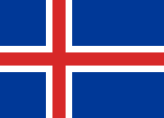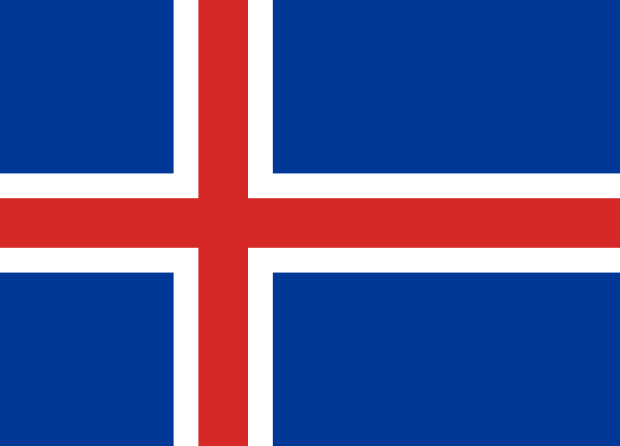
Iceland

Country flag available in this resolutions
| Icon 32x23 | ![]() |
| Icon 88x63 | ![]() |
Iceland
Iceland, an island nation situated at the confluence of the North Atlantic and Arctic Oceans, stands as a testament to the raw, untamed power of nature. This „land of fire and ice“, straddling the Mid-Atlantic Ridge, is one of the most geologically active places on Earth, constantly shaped by volcanic eruptions, geothermal activity, and the slow grind of glaciers. Its dramatic landscape, characterized by vast lava fields, towering volcanoes, expansive ice caps, and intricate fjords, offers a stark beauty that captivates all who visit. The island’s unique position means it experiences extremes of light, from the endless summer days under the midnight sun to the short, dark winters illuminated by the ethereal glow of the Aurora Borealis. This formidable geography has not only sculpted the land but also profoundly influenced its history, culture, and the resilience of its people, dictating settlement patterns and economic opportunities for centuries.
The history of Iceland began with the arrival of Norse settlers, primarily from Norway, in the late 9th century, making it one of the last large landmasses to be settled by humans. This period, vividly chronicled in the medieval Icelandic Sagas, led to the establishment of the „Althingi“ in 930 AD, widely considered the world’s oldest continuously operating parliament. For centuries, Iceland thrived as an independent commonwealth, developing a distinct literary and legal tradition. However, it eventually came under Norwegian rule in the 13th century, and subsequently Danish rule, enduring periods of hardship, including devastating volcanic eruptions, famine, and disease that severely tested the population’s endurance. Full independence was finally achieved in 1944, during World War II, marking a new chapter for the nation. Demographically, Iceland is one of the least populated countries in the world, with a population of approximately 380,000, predominantly of Norse and Celtic descent. The vast majority of its inhabitants reside in or around the capital city, Reykjavík, making it a highly urbanized society despite its sparse overall population. The Icelandic language, a North Germanic language, has remained remarkably close to Old Norse, a testament to the island’s relative isolation and a source of deep cultural pride and identity.
Iceland’s economy has undergone significant transformations over the centuries. Historically, it was heavily reliant on fishing and agriculture, with fish products remaining a vital export today. However, the abundance of geothermal and hydroelectric power has made Iceland a global leader in renewable energy, attracting energy-intensive industries such as aluminum smelting, which contributes significantly to the nation’s industrial output. It is tourism, though, that has emerged as the most rapidly growing sector in recent decades, drawing millions of visitors annually eager to experience its unique natural wonders, from the Blue Lagoon to the Golden Circle. This boom has provided substantial economic impetus and created numerous jobs, but also presents challenges related to infrastructure development and environmental preservation. Socially, Iceland is renowned for its high standard of living, robust welfare system, and strong commitment to gender equality, consistently ranking among the top nations in global equality indices. Education is highly valued, and the nation boasts a vibrant arts scene, from its rich literary heritage embodied by the Sagas to contemporary music, film, and design, reflecting a dynamic and creative society.
Despite its successes, Iceland faces its own set of challenges. Its small, open economy is susceptible to global market fluctuations, as dramatically demonstrated by the 2008 financial crisis which severely impacted its banking sector. Climate change poses a significant long-term threat, with its glaciers receding at an alarming rate, serving as a stark reminder of the global environmental crisis and its direct impact on the island’s iconic landscapes. Managing the burgeoning tourism industry responsibly, ensuring sustainable growth that benefits locals while preserving the delicate ecosystem, is another pressing concern. Furthermore, maintaining its unique cultural identity and language in an increasingly globalized world requires continuous effort and investment in education and cultural institutions. Yet, Iceland’s history of resilience, its innovative spirit, and its deep connection to nature suggest a nation well-equipped to navigate these complexities. From its ancient sagas to its modern technological advancements and its pioneering approach to renewable energy, Iceland remains a captivating and dynamic country, a beacon of sustainable living and a powerful example of how a small nation can carve out a significant presence on the world stage.
Information about country Iceland
Automated text translation, excuse errors, please!
Informations are from the publication CIA The World Factbook.
Country Iceland is situated in a location / continent Europe. Iceland has an area of 103 000 km2 and 313 183 residents. The highest point has a height 2 110 above sea level. and it is called Hvannadalshnukur. The lowest point is located at the level of 0 above sea level and it is named Atlantic Ocean. System of government is republic and the date of independence First December 1918. The capital city is Reykjavik. Iceland has the international abbreviation IC.
Iceland - economy
Total gross domestic product (GDP) is 12 570 000 000 $. Total gross domestic product per capita in purchasing power parity is 38 500 $. GDP grows by 3.10 % a year. Inflation (consumer price index) is equal to 4.00 % a year. Iceland have 175 700 working-age population (from a total population 313 183 people). Unemployment is at 7.40 %. Iceland issued 4.20 % GDP to healt care and 0,00 % GDP to army. The public debt of the country is 128.30 % GDP. The total amount of foreign debt is 124 500 000 000 USD.
Iceland - transport and telecommunications
Iceland has 12 869 km of roads and 99 airports. There is registered 2 ships.
Number of active mobile phones (sim card) in the country Iceland is 344 100. Number of active fixed telephone lines is 189 500. Iceland has 301 600 internet users, who have the available 360 910 Internet connections. Iceland has been assigned a domain first Choose range .is.
Iceland - demography
As suggested above, Iceland has 313 183 people. Population growth is in the amount 0.67 % per year. Number of children born per 1000 population per year is 13.23.Every mother has average 1.89 children. The infant mortality rate is 3.18 and maternal mortality 5.00 deaths per 100,000 births. Average estimated life expectancy makes 81.00 years. Mortality is 7.02 people per 1000 population per year.
Iceland - energetics
Iceland consumes a year 15 980 000 000 kWh of electricity. Annual electricity production is 16 770 000 000 kWh in power plants with a total installed electrical capacity 2 571 000 kW. Iceland exports 0 kWh and imports 0 kWh of electricity per year Energy mix of power generation is as follows: fossil fuels: 4.7 %, nuclear energy: 0 %, renewable: 22.4 %, hydropower: 72.9 %.
Flags of countries
World flags
World countries flags
Dále doporučujeme:
Odkazy na užitečné webové stránkyDoporučené internetové odkazy
Tipy na užitečné weby
Odkazy nejen na naše partnerské weby
Odkazy na zajímavé weby
![]() |
![]() |
![]() |
![]() |
![]() |
![]() |
![]() |
![]() |
![]() |
![]() |
![]() |
![]() |
![]() |
![]() |
![]() |
![]() |
![]() |
![]() |
![]() |