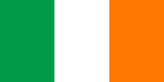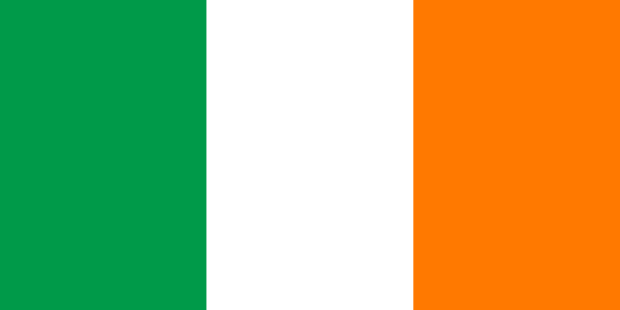
Ireland

Country flag available in this resolutions
| Icon 32x16 | ![]() |
| Icon 88x44 | ![]() |
Ireland
Ireland, often called the „Emerald Isle“ due to its lush green landscapes, is an island nation in the North Atlantic. Renowned for its rich history, vibrant culture, and breathtaking natural beauty, it has captivated hearts worldwide. From its ancient Celtic roots to its modern status as a thriving European economy, Ireland presents a fascinating blend of tradition and innovation, a story of resilience and enduring spirit.
Geographically, Ireland is Europe’s third-largest island, with the Republic of Ireland occupying about five-sixths of its total area. Its landscape features low-lying central plains surrounded by rugged coastal mountains. The dramatic coastline includes iconic cliffs like the Cliffs of Moher and numerous bays. The island is traversed by several rivers, most notably the Shannon. Its temperate oceanic climate brings mild winters, cool summers, and abundant rainfall, fostering the characteristic verdant scenery that has earned it its famous moniker.
Ireland’s history dates back thousands of years, first settled by Mesolithic hunter-gatherers, then by Celts around 500 BC, who established a rich cultural and linguistic heritage. Christianity arrived in the 5th century, famously propagated by Saint Patrick, transforming Ireland into a center of monastic learning during the early Middle Ages, earning it the title „Island of Saints and Scholars.“ Viking raids in the 9th century led to the establishment of towns like Dublin. The Norman invasion in the 12th century marked the beginning of centuries of English involvement, gradually leading to English dominance and the suppression of native Irish culture and language. The 17th century saw significant plantations of Protestant settlers from England and Scotland, particularly in Ulster, laying the groundwork for future sectarian divisions. The Great Famine of the 1840s, caused by potato blight and exacerbated by British government policies, devastated the population, leading to mass starvation, disease, and emigration, permanently altering Ireland’s demographic landscape. The late 19th and early 20th centuries were marked by growing nationalist movements and calls for Home Rule. The Easter Rising of 1916 and the subsequent War of Independence (1919-1921) led to the Anglo-Irish Treaty, which established the Irish Free State (a dominion within the British Empire) and partitioned the island, creating Northern Ireland. The Irish Free State became a fully independent republic in 1949, officially named the Republic of Ireland. The latter half of the 20th century saw „The Troubles“ in Northern Ireland, a period of violent ethno-nationalist conflict, which largely ended with the Good Friday Agreement in 1998, bringing a fragile but lasting peace.
The Republic of Ireland has a population of approximately 5.1 million people. English is the primary spoken language, though Irish (Gaeilge) is the first official language and is taught in schools, with Gaeltacht regions preserving its daily use. The population is predominantly of Irish ethnic origin, but immigration, particularly since the economic boom of the 1990s, has led to increased diversity, with significant communities from other EU countries, Eastern Europe, and beyond. Catholicism remains the largest religion, though its influence has waned, and the number of people identifying as having no religion has grown considerably. Ireland has a relatively young population compared to many other European nations, partly due to a historically higher birth rate and a return of emigrants during periods of economic prosperity. Urbanization is significant, with Dublin being the largest city and capital, home to over a quarter of the country’s population, followed by Cork, Limerick, and Galway.
Ireland’s economy has undergone a remarkable transformation in recent decades. Historically agrarian, it transitioned rapidly in the late 20th century to become a modern, knowledge-based economy, heavily reliant on trade and foreign direct investment. Dubbed the „Celtic Tiger“ during its boom years (mid-1990s to mid-2000s), Ireland experienced unprecedented economic growth, fueled by low corporate tax rates, EU membership, and a young, educated workforce. Key sectors now include information and communications technology (ICT), pharmaceuticals, medical technologies, and financial services. Many leading global technology companies, such as Google, Apple, Microsoft, and Facebook, have their European headquarters in Ireland. While the 2008 global financial crisis hit Ireland hard, leading to a severe recession and a bailout, the country has since made a strong recovery, demonstrating its resilience. Challenges include housing shortages, rising living costs, and the potential impacts of global economic shifts and Brexit, but its open economy and attractiveness to multinational corporations continue to drive its prosperity.
Irish culture is globally recognized for its richness and vitality. It boasts a proud tradition of literature, producing giants like James Joyce, W.B. Yeats, Samuel Beckett, and Seamus Heaney. Traditional Irish music, with its distinctive instruments like the uilleann pipes, fiddle, and bodhrán, is celebrated worldwide, often heard in lively sessions in local pubs. Dance, particularly step dancing, is another iconic cultural expression. The Irish people are renowned for their hospitality, wit, and strong sense of community. Sports, especially Gaelic football and hurling, play a central role in national identity, alongside rugby and soccer. Festivals like St. Patrick’s Day are celebrated with immense fervor both at home and among the global Irish diaspora, highlighting the enduring connection to their heritage.
From its ancient mystical landscapes to its dynamic modern cities, Ireland offers a unique tapestry of experiences. Its journey from a land scarred by famine and conflict to a prosperous, diverse European nation is a testament to its enduring spirit. With a vibrant culture, a resilient economy, and a warm welcome, the „Emerald Isle“ continues to enchant visitors and stands as a proud example of a nation that has successfully navigated the complexities of its past to build a promising future.
Information about country Ireland
Automated text translation, excuse errors, please!
Informations are from the publication CIA The World Factbook.
Country Ireland is situated in a location / continent Europe. Ireland has an area of 70 273 km2 and 4 722 028 residents. The highest point has a height 1 041 above sea level. and it is called Carrauntoohil. The lowest point is located at the level of 0 above sea level and it is named Atlantic Ocean. System of government is republic and the date of independence 6th December 1921. The capital city is Dublin. Ireland has the international abbreviation EI.
Ireland - economy
Total gross domestic product (GDP) is 183 900 000 000 $. Total gross domestic product per capita in purchasing power parity is 40 100 $. GDP grows by 0.70 % a year. Inflation (consumer price index) is equal to 2.60 % a year. Ireland have 2 126 000 working-age population (from a total population 4 722 028 people). Unemployment is at 14.40 %. Ireland issued 7.60 % GDP to healt care and 0,90 % GDP to army. The public debt of the country is 105.40 % GDP. The total amount of foreign debt is 2 352 000 000 000 USD.
Ireland - transport and telecommunications
Ireland has 96 036 km of roads, 3 237 km of railway lines and 39 airports. The total length of waterways (navigable rivers, canals, etc.) is 956 km. There is registered 31 ships.
Number of active mobile phones (sim card) in the country Ireland is 4 906 000. Number of active fixed telephone lines is 2 047 000. Ireland has 3 042 000 internet users, who have the available 1 380 000 Internet connections. Ireland has been assigned a domain first Choose range .ie.
Ireland - demography
As suggested above, Ireland has 4 722 028 people. Population growth is in the amount 1.11 % per year. Number of children born per 1000 population per year is 15.81.Every mother has average 2.01 children. The infant mortality rate is 3.81 and maternal mortality 6.00 deaths per 100,000 births. Average estimated life expectancy makes 80.32 years. Mortality is 6.38 people per 1000 population per year.
Ireland - energetics
Ireland consumes a year 26 100 000 000 kWh of electricity. Annual electricity production is 26 350 000 000 kWh in power plants with a total installed electrical capacity 7 401 000 kW. Ireland exports 242 000 000 kWh and imports 732 000 000 kWh of electricity per year Energy mix of power generation is as follows: fossil fuels: 75.3 %, nuclear energy: 0 %, renewable: 17.5 %, hydropower: 3.2 %.
Flags of countries
World flags
World countries flags
Dále doporučujeme:
Odkazy nejen na naše partnerské webyDoporučené odkazy na zajímavé weby
Doporučené odkazy a zdroje obsahu
Tipy na užitečné weby
Tipy na Partnerské weby
![]() |
![]() |
![]() |
![]() |
![]() |
![]() |
![]() |
![]() |
![]() |
![]() |
![]() |
![]() |
![]() |
![]() |
![]() |
![]() |
![]() |
![]() |
![]() |