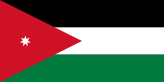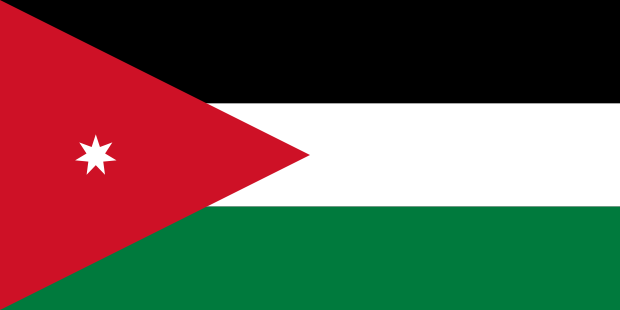
Jordan

Country flag available in this resolutions
| Icon 32x16 | ![]() |
| Icon 88x44 | ![]() |
Jordan
Jordan, officially the Hashemite Kingdom of Jordan, is a country in Western Asia, uniquely positioned at the crossroads of continents. Defined by its strategic location, profound history, and diverse landscapes—from the fertile Jordan Valley to the dramatic deserts of Wadi Rum—Jordan has maintained remarkable stability amidst regional turmoil. It serves as a crucial player in Middle Eastern diplomacy, often acting as a haven for refugees and a voice for moderation. Its capital, Amman, a vibrant blend of ancient heritage and modern development, encapsulates the nation’s dynamic spirit, reflecting a country that respects its past while actively building its future.
Geographically, Jordan is predominantly an arid to semi-arid land, spanning approximately 89,342 square kilometers. Its western frontier is marked by the Great Rift Valley, a geological marvel that encompasses the Jordan River, the Dead Sea—the lowest point on Earth and a unique natural wonder—and the Gulf of Aqaba, its sole maritime access. Eastward from the Rift Valley, the terrain gradually ascends to a highland plateau, where the majority of the population and major urban centers like Amman, Irbid, and Zarqa are located. Further east and south, the landscape transforms into the vast, iconic desert of Wadi Rum, famous for its majestic sandstone mountains and ancient petroglyphs. Jordan shares borders with Syria to the north, Iraq to the northeast, Saudi Arabia to the east and south, and Israel and the Palestinian West Bank to the west, a complex geopolitical reality that has deeply shaped its history and present-day challenges.
Jordan’s history is exceptionally rich and ancient, stretching back millennia. The region has hosted numerous civilizations, from early human settlements to the biblical Ammonites, Moabites, and Edomites. It later fell under the influence of powerful empires, most notably the Nabataeans, an ancient Arab people who carved the breathtaking city of Petra into sandstone cliffs, leaving behind one of the world’s most enduring and globally recognized archaeological marvels. The Roman Empire subsequently integrated the area into its Provincia Arabia, followed by the decisive Islamic conquests in the 7th century, which established Arabic as the dominant language and Islam as the predominant religion. For centuries thereafter, the territory was part of the vast Ottoman Empire until its collapse after World War I. Modern Jordan emerged from the British Mandate for Palestine and Transjordan, with Abdullah I, a son of the Sharif of Mecca, establishing the Emirate of Transjordan in 1921. Full independence was achieved in 1946, forming the Hashemite Kingdom of Jordan. Since then, Jordan has navigated numerous complex regional conflicts, including the Arab-Israeli wars, consistently advocating for peace, stability, and diplomatic solutions in the Middle East.
Demographically, Jordan’s population is approximately 11 million, a figure significantly impacted by successive waves of refugees over many decades. It is a relatively young nation, with a large proportion of its populace under the age of 30. The overwhelming majority of the population are Arabs, comprising various tribal affiliations and origins, including a substantial number of Palestinian refugees and their descendants, who constitute a significant portion of the populace. Smaller but historically significant ethnic groups include Circassians, Chechens, and Armenians, who have integrated into Jordanian society while retaining aspects of their cultural heritage. Sunni Islam is the state religion, practiced by over 95% of the population, while a Christian minority, primarily Greek Orthodox, makes up about 4%. Urbanization is high, with most Jordanians concentrated in cities like Amman, Irbid, and Zarqa, which places considerable pressure on existing infrastructure and natural resources. The continuous influx of refugees from neighboring conflicts, particularly from Iraq and Syria, poses ongoing humanitarian and developmental challenges, yet also fosters international cooperation and support for the kingdom.
Jordan’s economy, classified as an emerging market, is relatively small and notably lacks significant indigenous oil reserves, unlike many of its neighbors. Consequently, it relies heavily on services, especially tourism, and to a lesser extent, mining and manufacturing. Tourism is a vital sector, propelled by world-renowned attractions like Petra, Wadi Rum, the Dead Sea, and numerous historical and religious sites that draw visitors globally. The country is also a major global producer of phosphates and potash, which are crucial export commodities. Manufacturing industries include textiles, pharmaceuticals, and chemicals. Agriculture, while limited by severe water scarcity, contributes to the economy primarily through the cultivation of fruits and vegetables in the fertile Jordan Valley. Persistent economic challenges include high unemployment, particularly among the youth, and a substantial budget deficit. Water scarcity remains a critical long-term issue impacting all sectors of the economy and society. The nation depends significantly on foreign aid and remittances from Jordanians working abroad. Despite these formidable hurdles, the government is actively pursuing reforms to diversify the economy, attract foreign investment, and promote innovation, particularly in the burgeoning technology sector, aiming for sustainable growth and improved living standards for its citizens.
Jordan stands as a testament to resilience and pragmatic leadership, a beacon of stability in a turbulent region. Its unique blend of ancient heritage and modern aspirations, coupled with its crucial role as a regional mediator and humanitarian haven, underscores its global importance. Despite facing internal socioeconomic challenges and external geopolitical pressures, Jordan continues to chart its course with determination, striving for peace, prosperity, and a secure future for its diverse populace, embodying a spirit of perseverance and hope in the heart of the Middle East.
Information about country Jordan
Automated text translation, excuse errors, please!
Informations are from the publication CIA The World Factbook.
Country Jordan is situated in a location / continent Middle East. Jordan has an area of 89 342 km2 and 6 508 887 residents. The highest point has a height 1 734 above sea level. and it is called Jabal Ram. The lowest point is located at the level of -408 above sea level and it is named Dead Sea. System of government is constitutional monarchy and the date of independence 25th May 1946. The capital city is Amman. Jordan has the international abbreviation JO.
Jordan - economy
Total gross domestic product (GDP) is 37 370 000 000 $. Total gross domestic product per capita in purchasing power parity is 6 000 $. GDP grows by 2.50 % a year. Inflation (consumer price index) is equal to 4.40 % a year. Jordan have 1 771 000 working-age population (from a total population 6 508 887 people). Unemployment is at 12.30 %. Jordan issued 4.50 % GDP to healt care and 8,60 % GDP to army. The public debt of the country is 57.50 % GDP. The total amount of foreign debt is 7 644 000 000 USD.
Jordan - transport and telecommunications
Jordan has 7 891 km of roads, 507 km of railway lines and 18 airports. There is registered 12 ships.
Number of active mobile phones (sim card) in the country Jordan is 7 483 000. Number of active fixed telephone lines is 465 400. Jordan has 1 642 000 internet users, who have the available 49 083 Internet connections. Jordan has been assigned a domain first Choose range .jo.
Jordan - demography
As suggested above, Jordan has 6 508 887 people. Population growth is in the amount -0.97 % per year. Number of children born per 1000 population per year is 26.52.Every mother has average 3.36 children. The infant mortality rate is 15.83 and maternal mortality 63.00 deaths per 100,000 births. Average estimated life expectancy makes 80.18 years. Mortality is 2.74 people per 1000 population per year.
Jordan - energetics
Jordan consumes a year 11 640 000 000 kWh of electricity. Annual electricity production is 13 420 000 000 kWh in power plants with a total installed electrical capacity 2 616 000 kW. Jordan exports 139 000 000 kWh and imports 383 000 000 kWh of electricity per year Energy mix of power generation is as follows: fossil fuels: 99.3 %, nuclear energy: 0 %, renewable: 0.2 %, hydropower: 0.5 %. The country Jordan is harvested annually 20 barrels of oil.
Flags of countries
World flags
World countries flags

Dále doporučujeme:
Odkazy nejen na naše partnerské webyTipy na užitečné weby
Zajímavé internetové odkazy
Linky na partnerské weby
Zajímavé webové stránky
![]() |
![]() |
![]() |
![]() |
![]() |
![]() |
![]() |
![]() |
![]() |
![]() |
![]() |
![]() |
![]() |
![]() |
![]() |
![]() |
![]() |
![]() |
![]() |