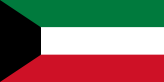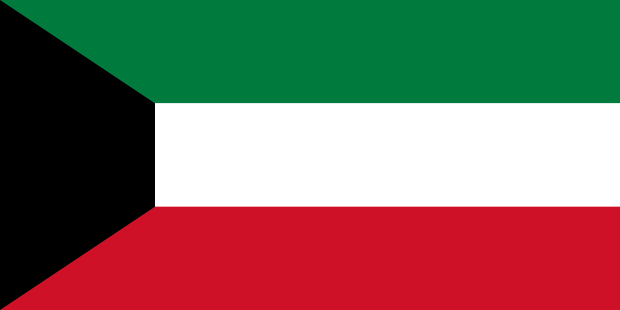
Kuwait

Country flag available in this resolutions
| Icon 32x16 | ![]() |
| Icon 88x44 | ![]() |
Kuwait
Kuwait, officially the State of Kuwait, is a small yet strategically significant country at the tip of the Persian Gulf. This oil-rich nation blends ancient Bedouin traditions and ultra-modern development, playing a pivotal role in regional and global energy markets. Despite its modest size, Kuwait boasts a rich history, diverse demographics, and a robust economy underpinned by vast hydrocarbon reserves, contributing to its unique standing in the Middle East.
Geographically, Kuwait is in the northeastern Arabian Peninsula, bordered by Saudi Arabia, Iraq, and the Persian Gulf. Covering approximately 17,818 square kilometers, it’s one of the world’s smaller countries, predominantly flat, sandy desert terrain. The climate is arid, with extremely hot summers often exceeding 45°C (113°F) and mild, short winters. The country includes several islands, but most of the population resides along the coastal strip, especially in Kuwait City. This strategic location has historically made Kuwait a vital trading hub and a critical point for global oil transportation.
Kuwait’s history is rooted in nomadic heritage and maritime trade. The modern state began in the early 18th century with the Al Sabah family’s rule. Fearing Ottoman expansion, Kuwait became a British protectorate in 1899, ensuring autonomy and fostering pearling and trade. The pivotal moment arrived in the 1930s with immense oil discoveries, irrevocably transforming its economy. Kuwait gained full independence from the United Kingdom on June 19, 1961, and rapidly modernized. However, its post-independence era was dramatically interrupted by the Iraqi invasion in August 1990, leading to the First Gulf War. A US-led international coalition liberated Kuwait in February 1991, profoundly shaping its foreign policy and national identity, emphasizing security and international cooperation.
Kuwait’s demographic makeup is distinctive, with a significant disparity between its citizen population and a large expatriate workforce. Total population hovers around 4.8 million, but less than 30% are Kuwaiti citizens. Over 70% are expatriates, primarily from other Arab countries, South Asia, and Southeast Asia, crucial to virtually every economic sector. Arabic is the official language, though English is widely spoken. Islam is the state religion, with the majority adhering to Sunni Islam, alongside a significant Shi’a minority. The population is highly urbanized, mostly residing in Kuwait City and its metropolitan areas.
Kuwait’s economy is overwhelmingly dominated by its vast oil reserves, among the world’s largest. Oil and gas production account for approximately 50% of its Gross Domestic Product (GDP) and about 90% of government revenues, making it highly susceptible to global oil price fluctuations. To counter this, the government has launched ambitious diversification strategies in its „New Kuwait 2035“ vision. This plan aims to transform Kuwait into a regional financial and commercial hub, reducing oil reliance through investments in infrastructure, technology, and human capital. Kuwait boasts one of the world’s highest per capita incomes and a robust welfare state providing extensive citizen benefits. The country also manages the Kuwait Investment Authority (KIA), one of the world’s oldest and largest sovereign wealth funds.
Kuwaiti culture is deeply rooted in Islamic traditions and Bedouin heritage, yet embraces modernity. Family values are paramount, and hospitality is a cornerstone of social interaction. While conservative, Kuwait is often considered one of the more open societies in the Gulf, particularly in media and parliamentary discourse. Traditional arts, music, and cuisine reflect its historical ties. Women in Kuwait enjoy significant rights, including the right to vote and run for office, and are increasingly prominent professionally. This coexistence of tradition with rapid modernization defines Kuwait’s unique societal fabric.
Kuwait operates as a constitutional monarchy with a semi-democratic political system. The Emir, currently Sheikh Nawaf Al-Ahmad Al-Jaber Al-Sabah, is the head of state with significant executive power. The country has an elected parliament, the National Assembly (Majlis Al-Umma), possessing considerable legislative authority, including approving laws and questioning ministers. This parliamentary system, relatively unique in the Gulf, allows for political debate and public participation. Political parties are not formally permitted, but blocs are common. The relationship between executive and legislative branches can be contentious, reflecting a vibrant, if challenging, political discourse within a traditional monarchy.
Kuwait stands as a compelling example of a nation navigating immense resource wealth, regional geopolitical sensitivities, and modernizing aspirations. Its journey from a humble pearling village to a wealthy, independent state has been remarkable. As it looks to the future, Kuwait grapples with economic diversification, social integration challenges, and maintaining stability in a volatile region. Its commitment to a welfare state and strategic global investments underscore its ambition for a prosperous, sustainable future beyond oil, solidifying its role as an important player on the global stage.
Information about country Kuwait
Automated text translation, excuse errors, please!
Informations are from the publication CIA The World Factbook.
Country Kuwait is situated in a location / continent Middle East. Kuwait has an area of 17 818 km2 and 2 646 314 residents. The highest point has a height 306 above sea level. and it is called bezejmenné místo. The lowest point is located at the level of 0 above sea level and it is named Persian Gulf. System of government is constitutional emirate and the date of independence 19th June 1961. The capital city is Kuwait. Kuwait has the international abbreviation KU.
Kuwait - economy
Total gross domestic product (GDP) is 155 500 000 000 $. Total gross domestic product per capita in purchasing power parity is 42 200 $. GDP grows by 8.20 % a year. Inflation (consumer price index) is equal to 4.70 % a year. Kuwait have 2 243 000 working-age population (from a total population 2 646 314 people). Unemployment is at 2.20 %. Kuwait issued 6.80 % GDP to healt care and 5,30 % GDP to army. The public debt of the country is 6.50 % GDP. The total amount of foreign debt is 41 730 000 000 USD.
Kuwait - transport and telecommunications
Kuwait has 5 749 km of roads and 7 airports. There is registered 34 ships.
Number of active mobile phones (sim card) in the country Kuwait is 4 400 000. Number of active fixed telephone lines is 566 300. Kuwait has 1 100 000 internet users, who have the available 2 730 Internet connections. Kuwait has been assigned a domain first Choose range .kw.
Kuwait - demography
As suggested above, Kuwait has 2 646 314 people. Population growth is in the amount 1.88 % per year. Number of children born per 1000 population per year is 20.96.Every mother has average 2.60 children. The infant mortality rate is 7.87 and maternal mortality 14.00 deaths per 100,000 births. Average estimated life expectancy makes 77.28 years. Mortality is 2.13 people per 1000 population per year.
Kuwait - energetics
Kuwait consumes a year 43 410 000 000 kWh of electricity. Annual electricity production is 51 320 000 000 kWh in power plants with a total installed electrical capacity 10 940 000 kW. Kuwait exports 0 kWh and imports 0 kWh of electricity per year Energy mix of power generation is as follows: fossil fuels: 100 %, nuclear energy: 0 %, renewable: 0.0 %, hydropower: 0.0 %. The country Kuwait is harvested annually 2 682 000 barrels of oil.
Flags of countries
World flags
World countries flags
Dále doporučujeme:
Zajímavé linky na nejrůznější webyTipy na Partnerské weby
Zajímavé webové stránky
Tipy na užitečné weby
Odkazy na zajímavé weby
![]() |
![]() |
![]() |
![]() |
![]() |
![]() |
![]() |
![]() |
![]() |
![]() |
![]() |
![]() |
![]() |
![]() |
![]() |
![]() |
![]() |
![]() |
![]() |