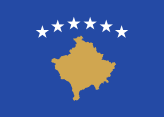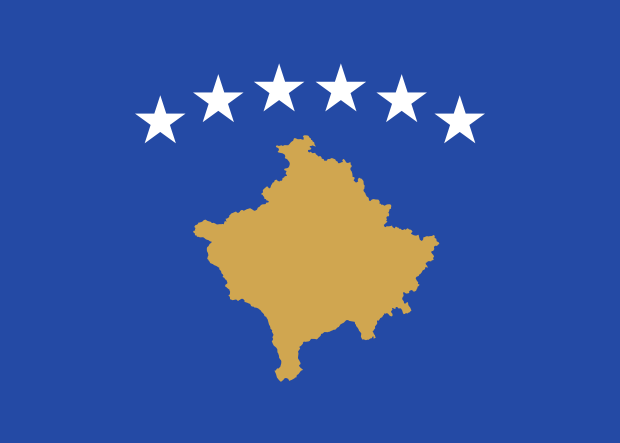
Kosovo

Country flag available in this resolutions
| Icon 32x23 | ![]() |
| Icon 88x63 | ![]() |
Kosovo
Kosovo, a landlocked territory in the heart of the Balkan Peninsula, represents a complex tapestry of ancient history, vibrant culture, and ongoing geopolitical challenges. Declaring its independence from Serbia in 2008, Kosovo’s statehood remains a subject of international debate, yet it has steadily forged its own path, striving for recognition and stability amidst a dynamic region.
Geographically, Kosovo is predominantly mountainous, characterized by the Šar Mountains in the south and southeast and the Prokletije range (Accursed Mountains) in the southwest. Its central plains, notably the Metohija basin (Dukagjini in Albanian) and the Kosovo Field (Fushë Kosova), are fertile and historically significant. The capital and largest city, Pristina (Prishtina), is situated in the northeast, serving as the country’s political, economic, and cultural hub. Rivers such as the White Drin, Sitnica, and Ibar crisscross the landscape, contributing to its diverse ecosystems. Its strategic location has historically made it a crossroads of civilizations, a factor that profoundly shaped its tumultuous past.
The history of Kosovo is long and layered, tracing back to Illyrian and Roman times. In the Middle Ages, the territory became a crucial part of the Serbian medieval state, with numerous monasteries and churches, such as the Patriarchate of Peć and Visoki Dečani, serving as vital cultural and religious centers. The pivotal Battle of Kosovo in 1389, where a coalition of Balkan forces confronted the invading Ottoman army, marked the beginning of nearly five centuries of Ottoman rule. During this period, a significant portion of the population converted to Islam, and Albanian identity began to solidify. Following the Balkan Wars in the early 20th century, Kosovo was incorporated into the Kingdom of Serbia, later becoming part of Yugoslavia. Under Tito’s communist rule, Kosovo gained significant autonomy as an autonomous province within Serbia. However, this autonomy was revoked by Slobodan Milošević’s regime in the late 1980s, leading to increased repression of the Albanian majority and the rise of Albanian nationalism. This culminated in the Kosovo War of 1998-1999, a brutal conflict that saw widespread human rights abuses and ethnic cleansing, ending only after NATO’s military intervention. Following the war, Kosovo was placed under UN administration (UNMIK) until its unilateral declaration of independence on February 17, 2008.
Demographically, Kosovo is overwhelmingly ethnically Albanian, constituting over 90% of its population of approximately 1.8 million people. The largest minority group is Serbs, concentrated primarily in the northern municipalities and various enclaves across the country. Other minority communities include Bosniaks, Turks, Roma, Ashkali, and Egyptians. Albanian and Serbian are the official languages, reflecting the country’s diverse ethnic makeup. The predominant religion is Islam, practiced by the majority Albanian, Bosniak, and Turkish communities, while Orthodox Christianity is the faith of the Serb population. This demographic composition, particularly the large Albanian majority and the distinct Serb minority, is a crucial factor in Kosovo’s political identity and its relationship with Serbia.
Economically, Kosovo is one of the poorest countries in Europe, grappling with high unemployment rates, particularly among its youth, and significant challenges in its transition to a market economy. The economy is heavily reliant on remittances from the large Kosovar diaspora, which account for a substantial portion of the GDP. Key sectors include agriculture, primarily focused on small-scale farming; services, especially retail and hospitality; and a nascent mining industry, with rich deposits of lignite, lead, zinc, and nickel. Efforts are underway to attract foreign investment and develop infrastructure, but issues such as corruption, an underdeveloped energy sector, and an unstable political environment continue to hinder growth. Membership in international financial institutions and agreements with the EU aim to facilitate economic development and integration, but the lack of full international recognition complicates trade and investment flows.
Despite the hurdles, Kosovo possesses a youthful and dynamic population, eager to build a prosperous future. Its journey from conflict to self-governance is a testament to its resilience. However, the path ahead remains challenging, marked by the ongoing dialogue with Serbia aimed at normalizing relations, the quest for full international recognition, and the imperative to strengthen democratic institutions and economic opportunities for all its citizens. Kosovo stands as a young nation, navigating the complexities of its past and present, while striving for a stable and integrated future within Europe.
Information about country Kosovo
Automated text translation, excuse errors, please!
Informations are from the publication CIA The World Factbook.
Country Kosovo is situated in a location / continent Europe. Kosovo has an area of 10 887 km2 and 1 836 529 residents. The highest point has a height 2 656 above sea level. and it is called Gjeravica/Deravica. The lowest point is located at the level of 297 above sea level and it is named Dogwood and Bardhe / Beli Drim. System of government is republic and the date of independence 17th February 2008. The capital city is Pristina (Prishtine, Prishtina). Kosovo has the international abbreviation KV.
Kosovo - economy
Total gross domestic product (GDP) is 13 020 000 000 $. Total gross domestic product per capita in purchasing power parity is 6 500 $. GDP grows by 5.00 % a year. Inflation (consumer price index) is equal to 8.30 % a year. Kosovo have 800 000 working-age population (from a total population 1 836 529 people). Unemployment is at 45.30 %. The public debt of the country is 5.60 % GDP. The total amount of foreign debt is 326 000 000 USD.
Kosovo - transport and telecommunications
Kosovo has 1 964 km of roads, 430 km of railway lines and 8 airports.
Number of active mobile phones (sim card) in the country Kosovo is 562 000. Number of active fixed telephone lines is 106 300.
Kosovo - demography
As suggested above, Kosovo has 1 836 529 people.
Kosovo - energetics
Kosovo consumes a year 5 674 000 000 kWh of electricity. Annual electricity production is 5 160 000 000 kWh ..
Flags of countries
World flags
World countries flags
Dále doporučujeme:
Zajímavé webové stránkyOdkazy na partnerské weby
Doporučené odkazy a zdroje obsahu
Linky na partnerské weby
Tipy na Partnerské weby
![]() |
![]() |
![]() |
![]() |
![]() |
![]() |
![]() |
![]() |
![]() |
![]() |
![]() |
![]() |
![]() |
![]() |
![]() |
![]() |
![]() |
![]() |
![]() |