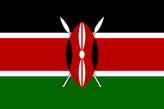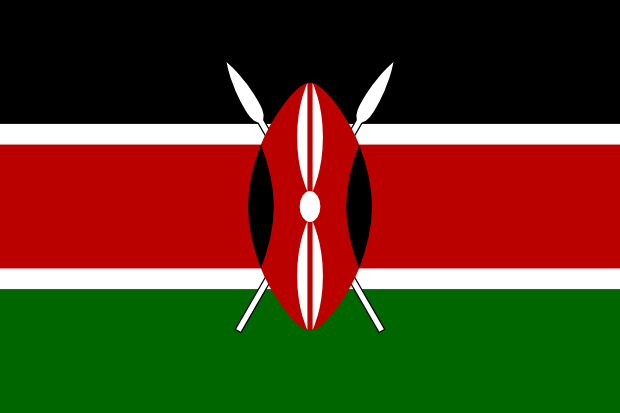
Kenya

Country flag available in this resolutions
| Icon 32x21 | ![]() |
| Icon 88x59 | ![]() |
Kenya
Kenya, officially the Republic of Kenya, is a captivating nation in East Africa, renowned for its breathtaking landscapes, incredible wildlife, and a vibrant cultural mosaic. Bordered by the Indian Ocean to the southeast, Tanzania to the south, Uganda to the west, South Sudan to the northwest, Ethiopia to the north, and Somalia to the northeast, Kenya stands as a geographical and economic anchor in the region. Its strategic location and diverse natural endowments have shaped its history and continue to define its trajectory on the global stage. From the snow-capped peaks of Mount Kenya to the sun-drenched coastal beaches and the vast savannahs teeming with wildlife, the country offers a microcosm of Africa’s stunning beauty and complexity.
The geography of Kenya is remarkably diverse, a characteristic that underpins much of its ecological richness and economic activity. Dominating the western half of the country is the spectacular Great Rift Valley, a geological marvel that runs north to south, creating a series of dramatic escarpments, active volcanoes, and a chain of alkaline and freshwater lakes such as Lake Turkana, Lake Naivasha, and Lake Nakuru, each supporting unique ecosystems. East of the Rift Valley lies the fertile central highlands, home to Mount Kenya, Africa’s second-highest peak, whose snow-capped summit is a stark contrast to the equatorial climate below. These highlands are crucial for agriculture, producing much of Kenya’s tea and coffee. To the west, the land slopes towards Lake Victoria, Africa’s largest lake, while the north is characterized by arid and semi-arid plains, supporting nomadic pastoralist communities. The eastern and southeastern parts of the country feature a low-lying coastal strip along the Indian Ocean, with coral reefs, mangrove forests, and historic Swahili port cities like Mombasa. This varied terrain contributes to a wide range of climates, from hot and humid along the coast to temperate in the highlands and arid in the north.
Kenya’s history is a rich tapestry woven from ancient migrations, vibrant trade, colonial imposition, and a hard-won struggle for independence. Evidence suggests human habitation in the region dates back millions of years, making it a cradle of humanity. Over centuries, various ethnic groups, including Cushitic, Nilotic, and Bantu peoples, migrated into the area, establishing diverse societies. The coastal areas developed into thriving Swahili city-states from the 7th century onwards, engaging in extensive trade networks across the Indian Ocean with Arab, Persian, and Indian merchants, exchanging gold, ivory, and slaves for textiles, spices, and manufactured goods. This era left a lasting legacy of Islamic culture and the Swahili language. The late 19th century marked the arrival of European powers during the „Scramble for Africa.“ Britain established the East Africa Protectorate in 1895, primarily to secure the route for the Uganda Railway. This led to significant land alienation for European settlers, creating deep-seated grievances among indigenous communities. The 20th century saw growing African nationalism, culminating in the Mau Mau Uprising in the 1950s, a fierce struggle against British colonial rule. Kenya finally gained independence on December 12, 1963, with Jomo Kenyatta becoming its first president. Post-independence Kenya experienced periods of one-party rule, political reforms leading to multi-party democracy in the 1990s, and significant challenges including ethnic tensions and political violence, particularly after the 2007 elections. Despite these hurdles, the nation has largely maintained its democratic institutions and is a regional leader in East Africa.
The demography of Kenya is characterized by its youthful and rapidly growing population, estimated to be around 55 million in 2023. The country is home to a remarkable diversity of over 40 distinct ethnic groups, each with its unique language and cultural traditions. The largest ethnic communities include the Kikuyu, Luhya, Kalenjin, Luo, Kamba, and the iconic Maasai, known for their distinctive semi-nomadic lifestyle and vibrant cultural heritage. This ethnic diversity, while enriching, has also historically been a source of political and social tension. The official languages are Swahili, which serves as the national lingua franca, and English, used in government, education, and business. Christianity is the dominant religion, practiced by the majority of the population, followed by Islam, particularly prevalent along the coast and in the northern regions, and various traditional African religions. Kenya is experiencing significant urbanization, with major cities like the capital Nairobi, a bustling hub of commerce and culture, and Mombasa, the principal port city, attracting large numbers of people seeking economic opportunities.
Kenya’s economy is the largest and most developed in East Africa, serving as a regional economic powerhouse. Its growth is primarily driven by a diverse set of sectors. Agriculture remains the backbone, employing a significant portion of the population and contributing substantially to the GDP. Key agricultural exports include high-quality tea, coffee, and horticultural products like fresh cut flowers and vegetables, which are major foreign exchange earners. The tourism sector is another vital pillar, leveraging Kenya’s world-renowned wildlife reserves, such as the Maasai Mara National Reserve, Amboseli, and Tsavo, offering iconic safari experiences, alongside its beautiful coastal resorts. The service sector, particularly financial services and telecommunications, has seen rapid growth, with Kenya being a pioneer in mobile money transfer services like M-Pesa. Manufacturing, though smaller, is gradually expanding, focusing on food processing, textiles, and consumer goods. Despite this progress, Kenya faces several economic challenges, including high rates of unemployment, particularly among the youth, significant income inequality, corruption, and vulnerability to climatic shocks affecting its rain-fed agriculture. However, ongoing infrastructure development, investment in technology, and its role as a regional trade and logistics hub offer promising avenues for continued growth and prosperity.
In conclusion, Kenya is a nation of profound contrasts and immense potential. Its rich history, stunning geographical diversity, vibrant demography, and dynamic economy paint a picture of a country that is both deeply rooted in tradition and forward-looking. While challenges such as poverty, inequality, and political stability persist, Kenya’s strategic importance, entrepreneurial spirit, and natural wealth position it as a critical player in Africa’s development story. It continues to attract global attention for its conservation efforts, technological innovation, and its enduring appeal as a land of unforgettable experiences.
Information about country Kenya
Automated text translation, excuse errors, please!
Informations are from the publication CIA The World Factbook.
Country Kenya is situated in a location / continent Africa. Kenya has an area of 580 367 km2 and 43 013 341 residents. The highest point has a height 5 199 above sea level. and it is called Mount Kenya. The lowest point is located at the level of 0 above sea level and it is named Indian Ocean. System of government is republic and the date of independence 12th December 1963. The capital city is Nairobi. Kenya has the international abbreviation KE.
Kenya - economy
Total gross domestic product (GDP) is 72 340 000 000 $. Total gross domestic product per capita in purchasing power parity is 1 800 $. GDP grows by 5.00 % a year. Inflation (consumer price index) is equal to 14.00 % a year. Kenya have 18 390 000 working-age population (from a total population 43 013 341 people). Unemployment is at 40.00 %. Kenya issued 12.20 % GDP to healt care and 2,80 % GDP to army. The public debt of the country is 49.90 % GDP. The total amount of foreign debt is 8 947 000 000 USD.
Kenya - transport and telecommunications
Kenya has 160 886 km of roads, 2 066 km of railway lines and 194 airports. There is registered 5 ships.
Number of active mobile phones (sim card) in the country Kenya is 29 981 000. Number of active fixed telephone lines is 283 500. Kenya has 3 996 000 internet users, who have the available 69 914 Internet connections. Kenya has been assigned a domain first Choose range .ke.
Kenya - demography
As suggested above, Kenya has 43 013 341 people. Population growth is in the amount 2.44 % per year. Number of children born per 1000 population per year is 31.93.Every mother has average 3.98 children. The infant mortality rate is 43.61 and maternal mortality 360.00 deaths per 100,000 births. Average estimated life expectancy makes 63.07 years. Mortality is 7.26 people per 1000 population per year.
Kenya - energetics
Kenya consumes a year 5 516 000 000 kWh of electricity. Annual electricity production is 6 573 000 000 kWh in power plants with a total installed electrical capacity 1 706 000 kW. Kenya exports 27 000 000 kWh and imports 38 000 000 kWh of electricity per year Energy mix of power generation is as follows: fossil fuels: 43.3 %, nuclear energy: 0 %, renewable: 12.9 %, hydropower: 43.8 %.
Flags of countries
World flags
World countries flags

Dále doporučujeme:
Odkazy na partnerské webyOdkazy na užitečné webové stránky
Doporučené internetové odkazy
Zajímavé linky na nejrůznější weby
Doporučené odkazy
![]() |
![]() |
![]() |
![]() |
![]() |
![]() |
![]() |
![]() |
![]() |
![]() |
![]() |
![]() |
![]() |
![]() |
![]() |
![]() |
![]() |
![]() |
![]() |